Saudi Arabia’s amended Labor Law continues to govern private-sector employment in the Kingdom in 2026.
The amendments took effect on February 19, 2025. They are not a separate labor law introduced in 2026.
The changes affect overseas Filipino workers through clearer rules on fixed-term contracts, resignation, workplace treatment, leave, and employer compliance.
However, domestic workers are covered by separate regulations. Household service workers should not assume that every rule below applies to their employment.
Rule 1: Expat contracts must have a fixed term
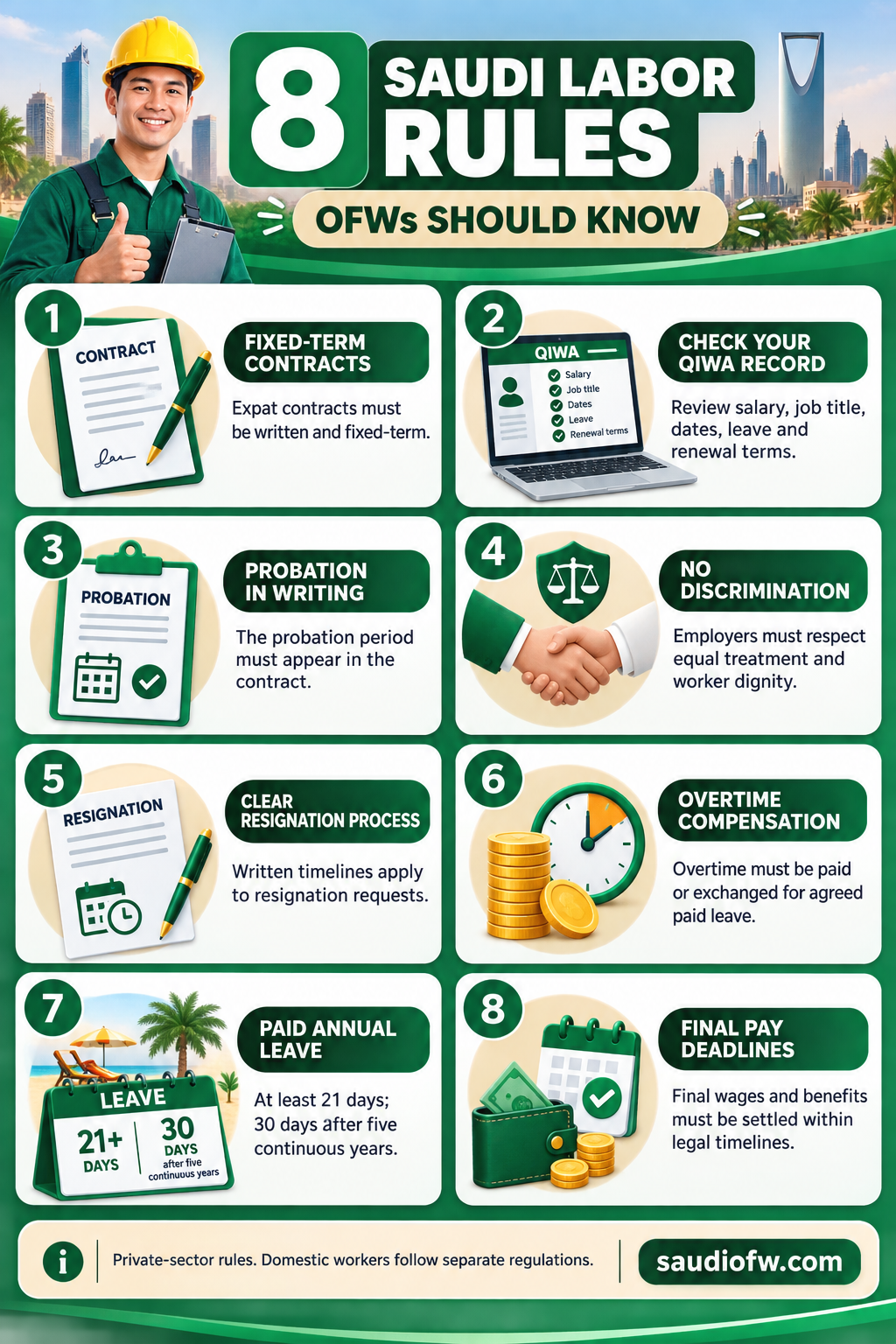
Under Article 37, the employment contract of a non-Saudi worker must be written and fixed-term.
If the contract does not state its duration, it will be treated as a one-year contract starting from the worker’s actual first day of work.
If both sides continue the employment after that period, the contract is considered renewed for a similar period.
A fixed-term contract normally ends on its stated expiry date unless it is renewed.
OFWs should check any notice period required if they do not want the contract renewed. Choosing not to renew is different from resigning before the contract expires.
Rule 2: Workers can review contracts through Qiwa
Employment contracts must be documented under Saudi regulations.
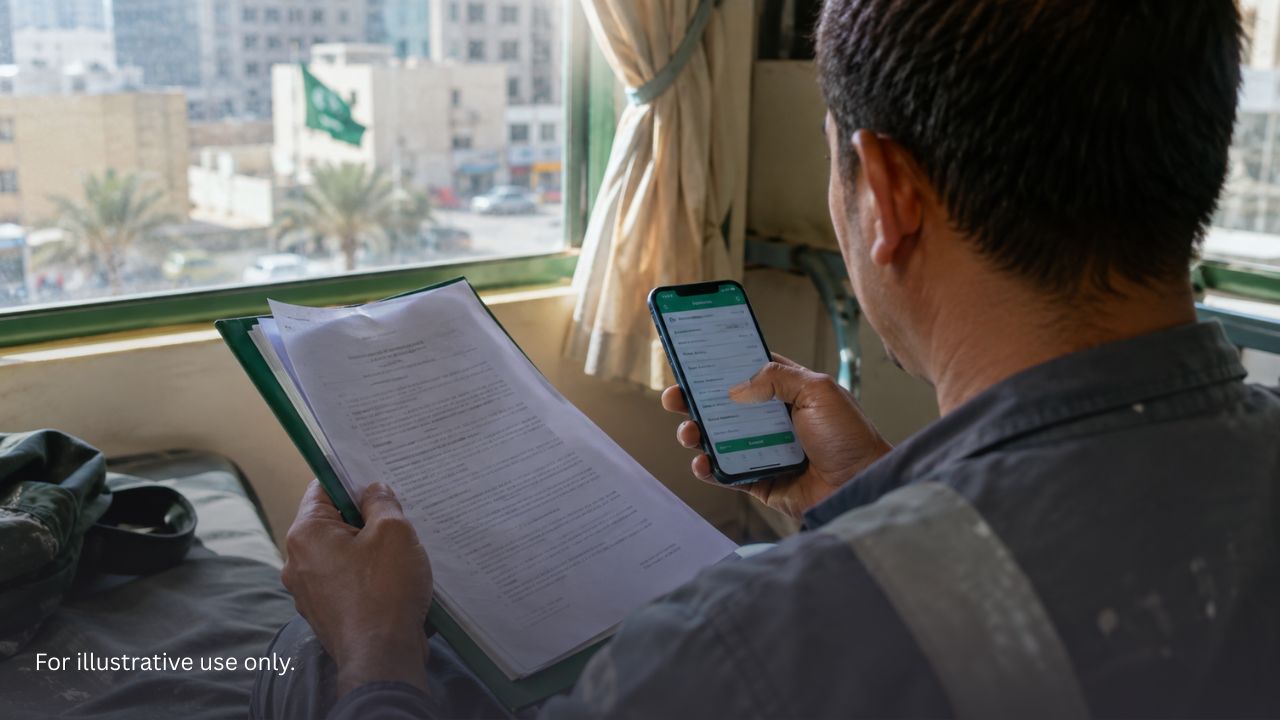
Through the official Qiwa employment contract service, workers can view their contract and respond to an employer’s offer.
An employee may accept, reject, or request changes to the proposed terms.
Before accepting, workers should check the salary, allowances, job title, workplace, contract dates, working hours, leave, probation, and renewal conditions.
They should not accept a Qiwa contract containing details that are different from the job offer or agreement they received.
Rule 3: Probation must appear in the contract
A probation period must be clearly stated in the employment contract.
Saudi rules allow probation to last up to 180 days under the conditions set by law.
During probation, either side may be allowed to end the contract, depending on its terms.
If the contract ends during this period, the worker may not receive compensation or an end-of-service award for that employment period.
An employee generally cannot be placed on probation more than once by the same employer. Limited exceptions may apply when the worker moves to a different job or when at least six months have passed since the earlier employment ended.
Rule 4: Discrimination and humiliating treatment are banned
Article 61 prohibits employers from weakening equal treatment or opportunity through discrimination.
Protected grounds include race, color, sex, age, disability, marital status, and other recognized forms of discrimination.
Employers must also respect workers and avoid words or actions that harm their dignity or religion.
The protection covers current employees and people applying for jobs.
Workers should keep records of discriminatory messages, notices, or employment decisions if they may need to report a violation.
Rule 5: Resignation now follows a clearer process
A resignation request is considered accepted if the employer does not respond within 30 days.
An employer may postpone acceptance for up to 60 days when work needs require it. The reason must be given to the worker in writing before the initial 30-day period ends.
The employee may withdraw the resignation within seven days of submitting it, unless the employer has already accepted the request.
The contract remains active during the resignation process. Both the employer and worker must continue meeting their obligations.
Resigning before a fixed-term contract ends may have legal or financial effects. Workers should review their contract and use the official Qiwa process instead of simply stopping work.
Rule 6: Overtime must be paid or properly exchanged
The standard limit is generally eight actual working hours per day or 48 hours per week.
Different limits and exceptions may apply to certain jobs, industries, shift arrangements, and Ramadan working hours for Muslim employees.
For overtime, an employer must pay the worker’s hourly wage plus an additional amount equal to 50% of the basic hourly wage.
Work performed during public holidays is also treated as overtime.
An employer may give paid compensatory leave instead of overtime pay, but this requires the worker’s consent.
OFWs should keep their schedules, time records, and payslips if their overtime is missing or incorrectly calculated.
Rule 7: Annual leave cannot simply be removed
A worker is entitled to at least 21 days of paid annual leave each year.
This increases to at least 30 days after five consecutive years with the same employer.
The employer must normally give at least 30 days’ notice of the scheduled leave.
Leave may be postponed for work reasons for up to 90 days. Any longer postponement requires the worker’s written consent and cannot extend beyond the end of the following year.
Workers cannot waive their annual leave while still employed in exchange for cash.
Rule 8: Final wages have a payment deadline
When the employer ends the employment relationship, wages and other entitlements must generally be settled within one week.
If the worker ends the contract, settlement must generally be completed within two weeks.
End-of-service benefits are normally calculated using half a month’s wage for each of the first five years and one month’s wage for every following year.
The amount can change when the worker resigns, depending on the length of service and circumstances.
At the worker’s request, the employer must also provide a free service certificate and return documents deposited by the worker.
What OFWs should do now
OFWs should compare their signed documents with the contract recorded in Qiwa.
Keep copies of the contract, payslips, bank records, leave approvals, work schedules, resignation notices, and employer messages.
Private-sector workers may report suspected labor violations through the Saudi Ministry of Human Resources and Social Development. Its official service lists 19911 as the contact number.