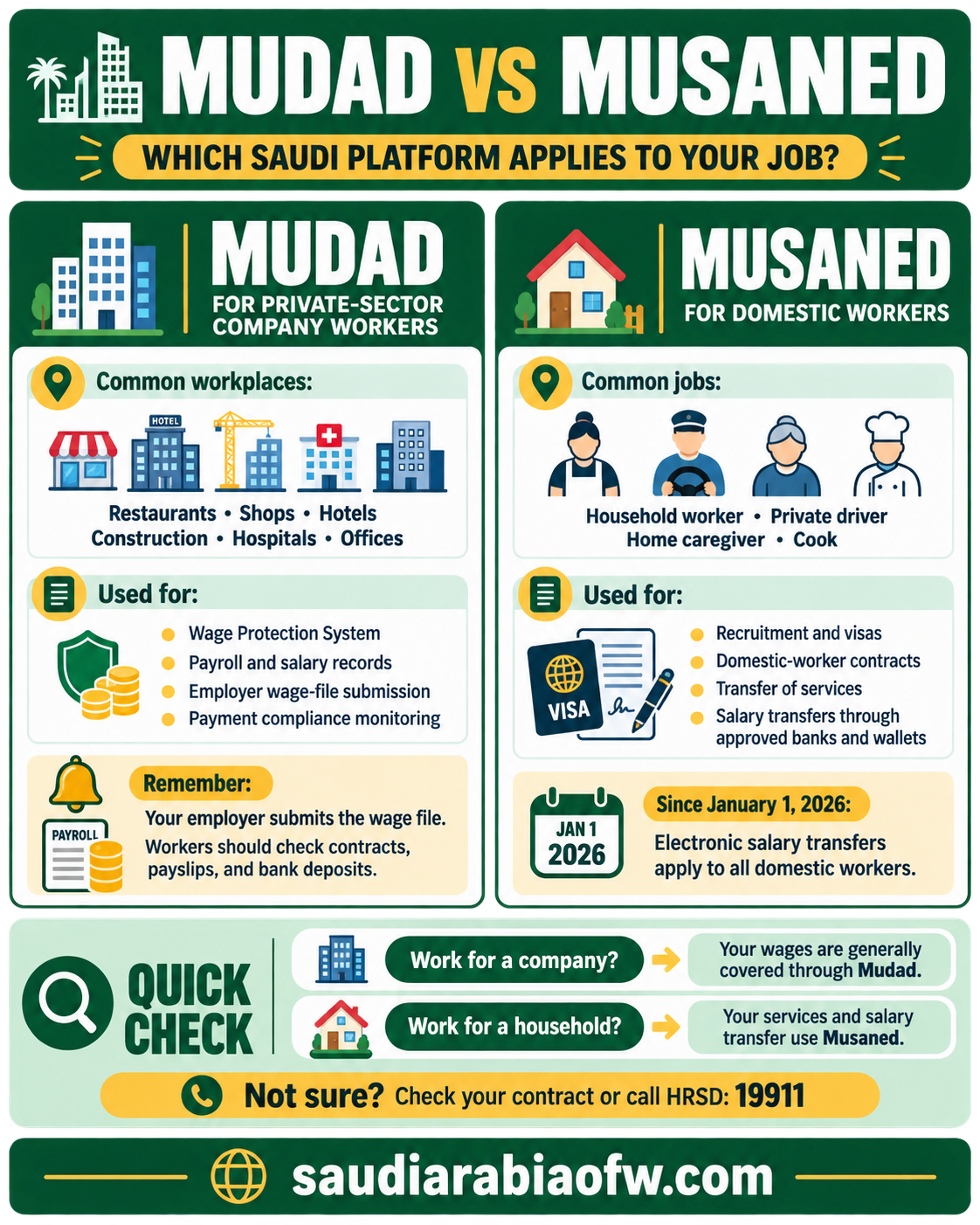
Mudad and Musaned are Saudi digital platforms connected to employment services, but they are not interchangeable.
The main difference is the worker’s employment category.
Mudad applies mainly to employees of private-sector establishments, such as restaurants, construction companies, shops, hospitals, hotels, and offices.
Musaned is designed for domestic workers hired by individuals or households.
This group may include household service workers, private drivers, home-based caregivers, cooks, and other occupations covered by Saudi domestic labor rules.
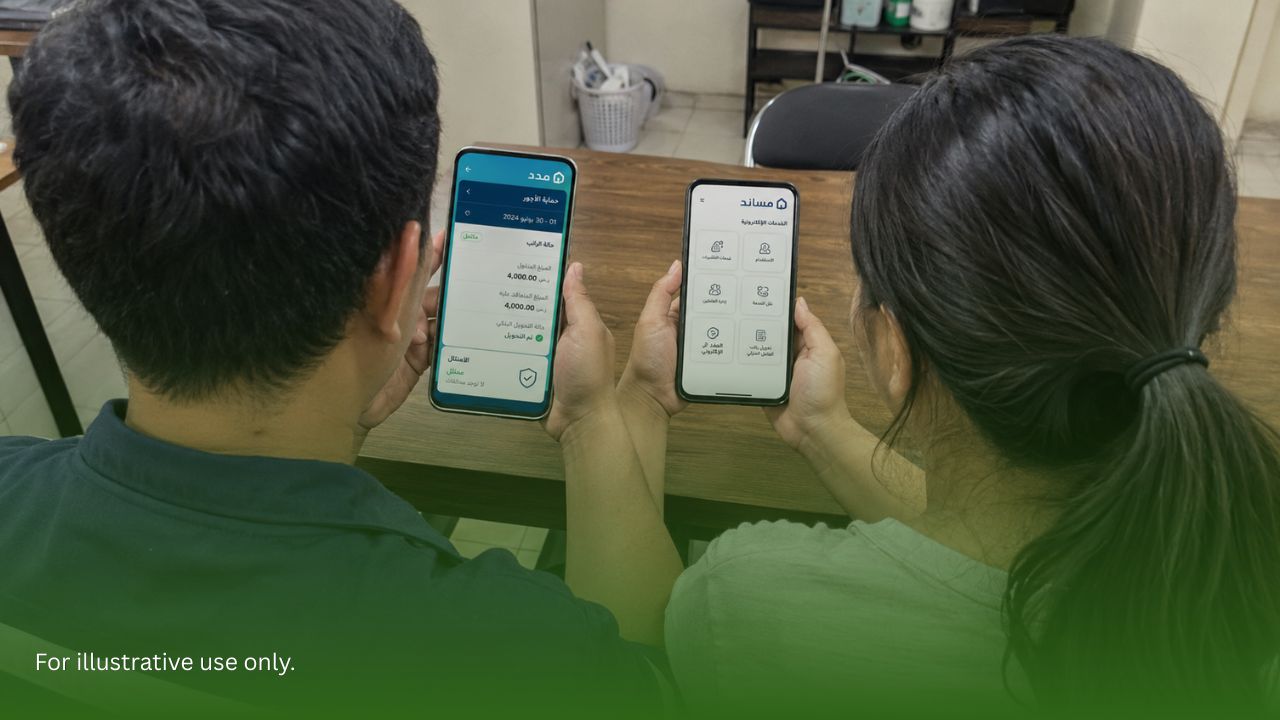
Mudad checks company salary compliance
Mudad supports Saudi Arabia’s Wage Protection Program for private-sector companies.
Employers use the platform to submit wage files and manage payroll information.
The system helps authorities compare salary transfers with the amount and payment date agreed upon in the employment relationship.
According to the Ministry of Human Resources and Social Development, more than one million establishments were registered on Mudad in 2025, representing 94% of private-sector establishments.
An OFW does not normally upload the company’s wage file.
That responsibility belongs to the employer or its authorized payroll representative.
Workers should instead check their bank deposits, payslips, and documented employment contract.
A delayed or reduced salary can be raised through official labor-dispute channels.
Musaned covers recruitment and household employment
Musaned manages a wider employment journey for domestic workers.
The platform allows employers to use licensed recruitment providers, select occupations and recruitment countries, issue or cancel visas, document recruitment contracts, transfer services, and access contract insurance.
It also connects domestic-worker salary payments with approved banks and digital wallets.
Under the Domestic Worker Salaries service, the employer selects the worker and transfers the monthly wage using a linked financial channel.
The payment creates a digital salary record that can help both parties if a disagreement occurs.
All domestic-worker salaries now require e-transfer
Saudi Arabia completed the final phase of mandatory electronic domestic-worker salary transfers on January 1, 2026.
The rule now applies to all employers of domestic workers.
HRSD says the worker’s mobile number must be linked to the residency number.
The worker also needs a bank account or digital wallet in their name.
The employer then uses the approved salary-transfer service connected to Musaned.
More details are available in the ministry’s final-phase announcement.
Check the contract category before taking action
An OFW employed by a company should generally look to Mudad-related wage protection and private-sector labor services.
A worker employed inside a household should use Musaned and domestic-worker channels.
Workers who are uncertain about their classification can review their contract and contact HRSD at 19911 before filing a complaint.