Saudi Arabia’s Wage Protection System, or WPS, helps authorities monitor whether private-sector employers pay workers correctly and on time.
Employers submit wage files through the Mudad platform.
These records allow the Ministry of Human Resources and Social Development, or HRSD, to compare actual salary payments with the amount and payment schedule agreed upon in employment contracts.
According to HRSD’s WPS service page, the program covers private-sector establishments.
HRSD reported that more than 10 million workers had their wages documented through the platform by the end of 2025.
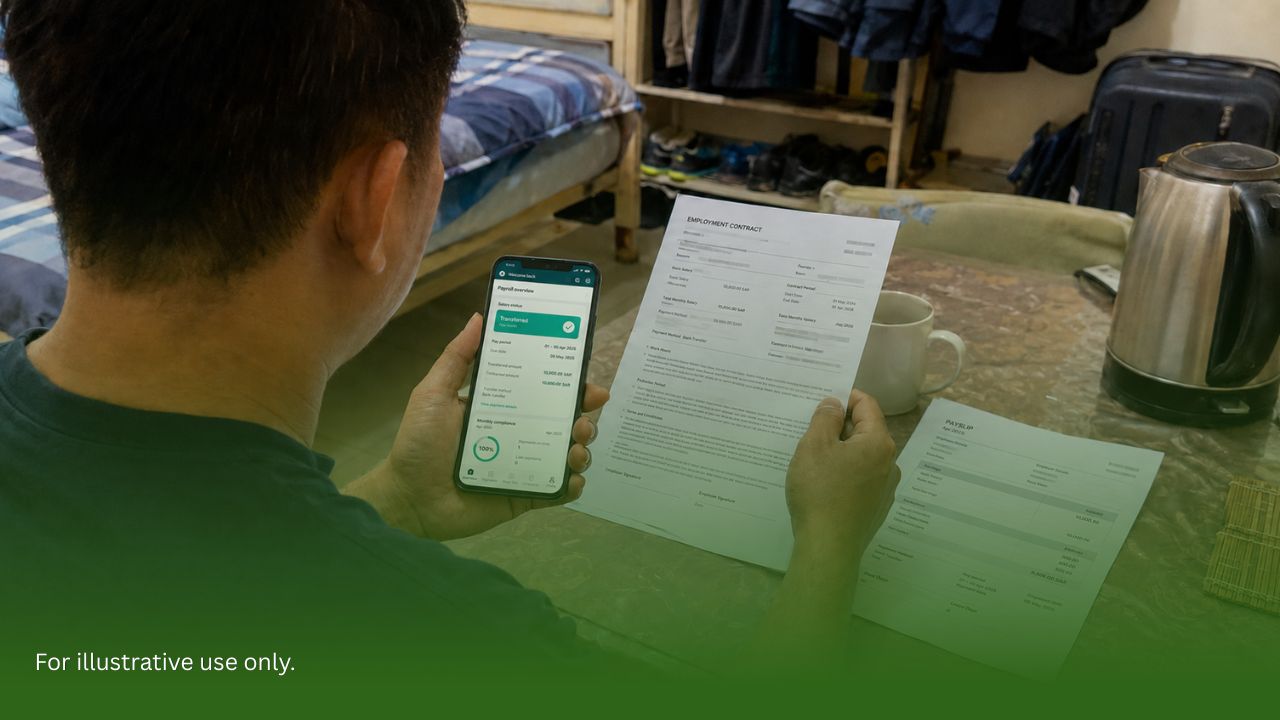
Missing or reduced payments can be detected
WPS does not simply record that an employer sent money.
It can also help identify differences involving the payment date and amount.
A possible compliance issue may appear if the employer pays late, pays less than the agreed wage, or fails to submit an accurate wage file.
Since March 1, 2025, employers have had 30 days instead of 60 days to upload their wage-protection files.
HRSD said the shorter period helps improve accuracy and supports timely payment. Details are available in the ministry’s official announcement about the 30-day submission period.
Your contract and bank record still matter
OFWs should regularly compare their bank deposits with the salary written in their documented Qiwa contract.
Workers should save copies of:
- Their Qiwa employment contract
- Bank statements or salary-transfer records
- Payslips
- Messages about delayed or reduced pay
- Attendance records, when relevant
These records may help if the employer claims that the salary was already paid or that a deduction was authorized.
Workers should first ask the employer or payroll department about a possible processing error.
However, a repeated or unresolved delay may require an official complaint.
Unpaid wages may qualify for faster enforcement
Saudi Arabia now recognizes the wage clause in certain documented employment contracts as an enforceable instrument.
HRSD says an eligible worker may apply through the Najiz platform when a full wage remains unpaid for 30 days after its due date.
For a partial wage, the waiting period is 90 days.
The contract must meet the documentation requirements stated in the official enforceable employment contract program. Workers should confirm their eligibility before applying.
An OFW may also use the Friendly Settlement for Labor Disputes service or call HRSD at 19911.
Domestic workers follow a separate wage-protection system through Musaned, so they should use the service that applies to their contract type.